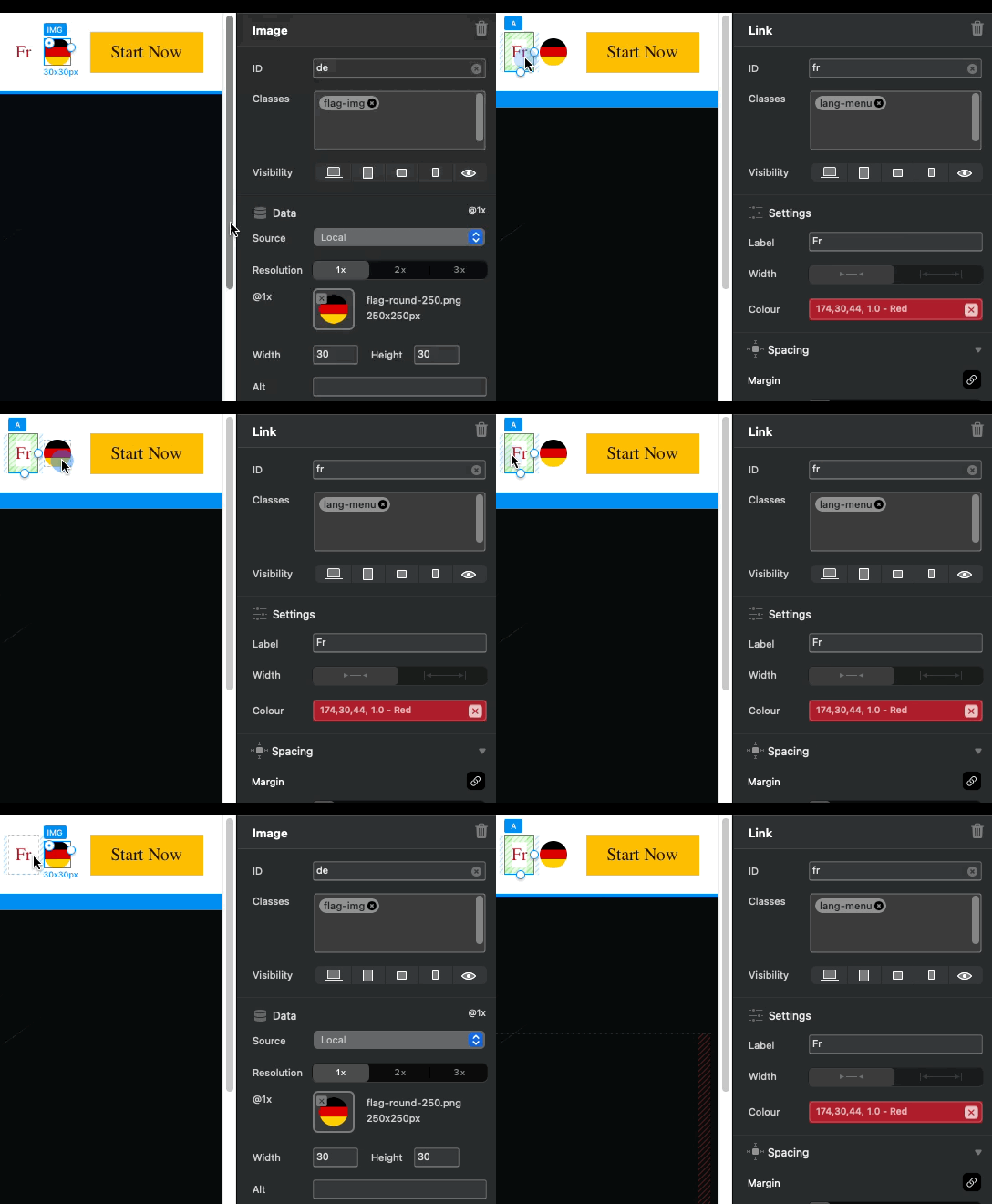
I also prefer using a 2-digit country code. For example, if you’re in Belgium, you could be French or Dutch speaking, so you would choose either FR or NL.
But if it’s possible, that would be great! Maybe in the settings, you could add a choice between displaying flags or 2-digit country codes.
The markings, codes, flags are all given according to the international ISO standard and can be used according to them.
I just want to note that the translation systems do not identify based on country codes, but on the basis of language codes, so language codes must be used here as well, but I made it so that the country identifier also appears in the url and in the source code for the hreflang tags.
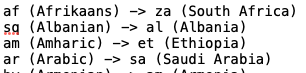
Whoever downloads the brick will find a file in which the language codes are described and paired with the country codes.
I made it by entering the name you want, you don’t have to write the full country name, and if someone doesn’t like the flags, they can use their own. What is important is that the language identifiers are specified accurately.
Obviously, if someone doesn’t want to not use the automatic flags, it’s optional.
Finally, I decided to make another version of the translator I was thinking about, and it was already discussed here.
In this case, the content of the website is not automatically translated, but is displayed in the original language as it was prepared.
A small window will ask you in which language you want to continue browsing the website.
You can see in the video that the other functions are also available, so you can also use the language selection menu.
If we go back to the Original appearance, the system detects that the website does not display the page again in the language of the browser.
The small window has a close button, if you close it, it will not appear again, only if the history is deleted.
Both Bricks will be included in the package, so if someone wants to choose the version to translate the website automatically, he can do that, and also to decide how he wants to translate it or not.
To the best of my knowledge, it is not prohibited to integrate Google Translate in any form in the EU, take Google Widet as a basis, which can be integrated into websites at the top of the page, it’s one thing how it looks.
There might also not be a law forbidding you to integrate hosted google fonts into your website. But there are GDPR laws requiring you to gather user consent.
When you use your Google fonts, and not getting the user consent before, the IP address of the user will be transferred to Google, and so on… most probably the same with Google translation services, when the IP address of the user is send to Google for getting the translation data…
As said, don’t shoot the messenger. I just want to make you aware of possible implications.
A secondary translator means that there is a backup API that comes into play when the primary API might fail or is overloaded and cannot perform its task.
The translator itself only translates the content of the website, so no user data is forwarded to Google.
I’m still working on a few solutions so that literally no personal data gets to google translator by accident, and it won’t, because obviously the brick won’t be released until then.
The translation is limited to the content of the website, which does not belong to the visitor, but to the operator, and not to any personal data of the user, therefore the EU cannot do anything, since no personal data is transmitted.
Anyway, I’m bored as hell with the nonsense of the EU, I’m just constantly annoyed by them, and I’m not specifically thinking about this thing right now. Everything they are doing is getting worse, see for example what they are doing with Apple.