It’s that time of year again, Apple are about to unleash their latest OS versions! These changes usually shape the future of Blocs, so it’s always an interesting time of year for us.
Not much has leaked in the lead up, so it’s hard to know what to expect. Maybe something radical like Mac apps on iPads or an Apple robot powered by Siri that can make me my 11am cup of coffee.
Im always interested in the VisionOS updates, but I have a feeling it’s going to be super light this year for the Vision Pro.
With the MacBook Ultra featuring Touch support expected to be released later this or next year, I’m curious about Apple’s approach to the macOS/iPadOS software changes. While I don’t hold high hopes for the integration of Mac apps on the iPad, it would be a significant improvement.
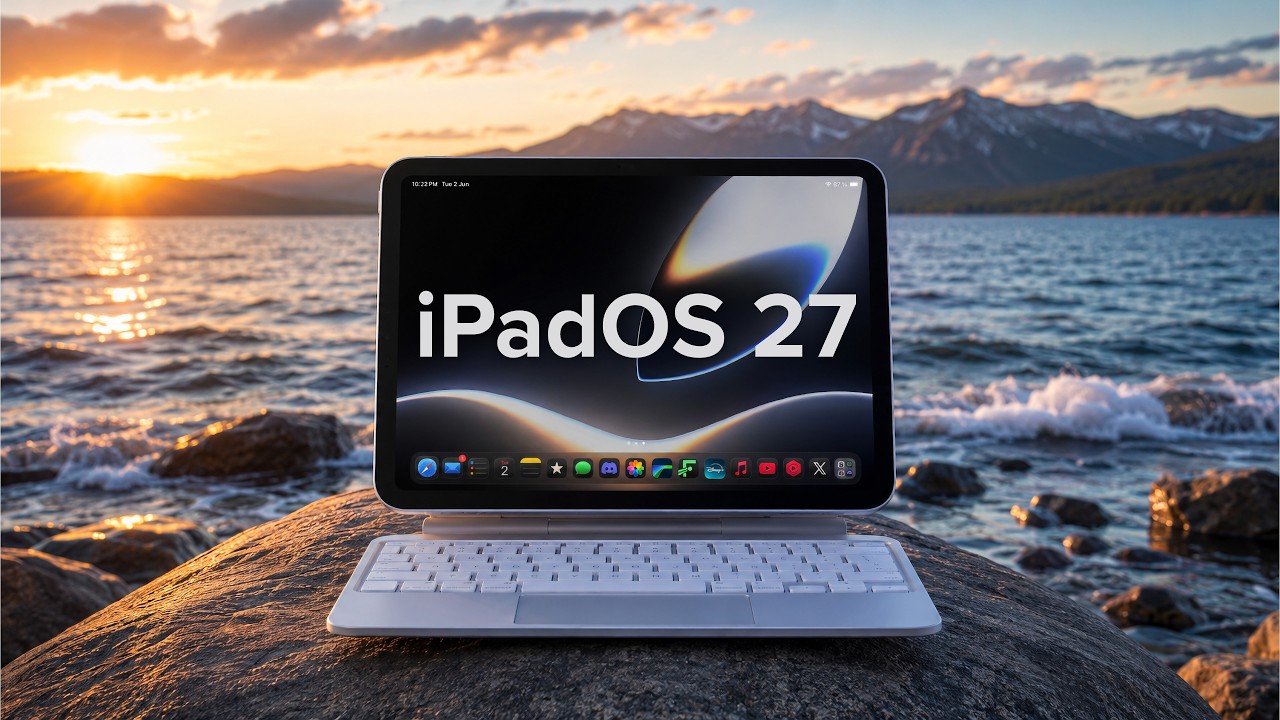
I recently created a video showcasing my ‘wishlist’ for iPadOS, with Blocs being a prominent feature, of course
I’ve often thought what if iPadOS had an app icon in the dock that launched MacOS in window / workspace on the iPad. You never know this may be the year.
I would like to see more integration with Ai. Apple to me seems to be so far behind in this area, but moving to a more serious pro version of Ai for businesses built into OS would be my huge request.
It would be great for solo workers and even people who have huge companies have an Ai co-worker built into the devices, like prompting me to get up….talk to me, being like a real life office working.
Grok have the talk feature working great, Grok is powerful in that area. I think Siri is sluggish and to be honest - boring!!!
Yes we can download apps and use others….but surely Apple can be a force in this area and have all our devices talk.
Apple has basically run out of runway and has suffered a bruising narrative around their AI, they need to finally correct course today and catch up. But its highly unlikely to be a jaw-dropping “iTunes moment” that shatters the entire AI landscape, instead just the necessary architectural corrections where Apple finally fixes its own fragmented deficient AI issues and gets its users interacting with their own devices universally and seamlessly. That alone would be a colossal win, this is their moment to finally get their software side of AI right.
They have the architectural advantage in their machines with the most capable consumer hardware pipeline just waiting to be set free by the OS, hopefully the software execution finally catches up along with the supply chain eventually. Exciting times once they correct their software deficit and get everything back on track. Then the hardware advantage will be even more profound - once they can actually can offer the physical supply to the demand (Steve Jobs would have predicted that right!).
For everyday consumers looking to get a smarter Siri, etc., today is great. But for the professional developer ecosystem WWDC will happen in a structural vacuum as part of an anticlimactic bottleneck, waiting for those new Macs. The monthly AI cloud-subscription treadmill will continue with cloud AI platforms laughing all the way to the bank at Apples Mac supply chain woes. WWDC will be the equivalent of being invited to a massive feast only to be told the kitchen is closed until October at the earliest.
It’s good to see image playground has been improved and made more useful. As for the rest, I’m looking forward to watching all of the sessions and seeing what has improved with the foundation models.
It looks like Xcode 27 beta 1 only lets you set MacOS Sonona as a minimum development target, which means it has dropped 3 versions of MacOS since the current release of Xcode 26.
And the fact Xcode 26 doesn’t run on macOS 27, is going to force many app developers to drop support for older versions of MacOS (Big Sur, Monterray & Ventura).
Apple are really pushing to get away from Intel at a bit of a pace now.
After some more digging it looks like you can compile for MacOS 12.4 minimum (which is good), it’s currently not shown in the list of Minimum Deployment options in Xcode 27, but it works, maybe a beta 1 bug or intentional.
I think Mac users often forget that Apple isn’t really a software company. AI is all about software, and only companies that are all about software are going to fully embrace it. Apple focuses on making products for regular people who aren’t tech nerds or computer whizzes. The Mac was famously marketed as “the computer for the rest of us,” aimed at those who found IBM computers too complicated. That’s why suddenly every family had a computer at home, thanks to Apple.
Now, AI is the latest buzz, and every software company is feeling confident because it’s advancing so quickly. People think of Apple as being behind because they don’t seem as involved. But honestly, they’re just choosing not to rush. Apple introduced Siri AI back in 2024 and realized that AI isn’t quite there yet, and that’s the truth. I have a $10,000 AI Local Workstation with agents that do amazing things for me; I can build apps just by typing prompts. If you think my setup makes AI seem incredible, I’ve got news for you: we’re just like the IBM PC users of the past now.
Apple’s role is to simplify how we use AI today, making it seamless and easy enough for a kid to understand. That’s what they’ve always done, and that’s why they appear to be lagging. I know they only introduced a chatbot for Siri because of pressure from competitors, which really feels like a PC move, and Apple doesn’t want to be seen as a copycat. Give them a couple of years, maybe two to four, and you’ll see how AI was meant to be used once they figure it out. That’s just how Apple operates.
Apple has been heavily involved in ML and documented research since at least 2017, when they also released the first version of the Neural Engine in their hardware. It’s been behind the scenes in their products for a long time. If I recall, even norm was surprised at what was available when he first implemented the Blocs AI Assistant.
Their approach was just different to what emerged in 2022 with the large scale generative AI, where LLMs… ie ChatGPT shifted people’s expectations. When your core values have a high level for user privacy, I think training a LLM becomes difficult, they are well positioned for on device smaller models though.
It’s a long race, and I think a lot of companies are discovery just how expensive it is to keep expanding these LLMs, not just in training, but serving them also.
“Historically in technology, efficiency often becomes more important than raw power once a market matures“
Apple maybe wise to take their time, let the others chew through their cash. Everything may look different in a few years time.
Slow‑rolling is an understatement for what Apple has already been doing with Siri since acquiring Siri Inc. in 2010 and releasing their version within iOS 5 in 2011. Without Steve Jobs, they essentially let it stagnate for a decade+ under Tim Cook, while others built the future. Apple is now essentially paying two of its fiercest rivals to keep its assistant from looking incompetent. After missing the initial LLM pivot, Apple panicked, they rushed out “Apple Intelligence,” delayed and re‑architected it, and ultimately outsourced parts to avoid further delays. Apple turned to Google’s Gemini infrastructure and NVIDIA Blackwell chips in the cloud, the kind of horizontal dependency Steve Jobs would have despised. He undoubtedly would have pivoted much sooner and pushed to realize his long‑held (1983/85) vision for deeply integrated intelligence. Had he lived longer, things assuredly would have already been vastly different for Apple, it would have been great to see what he could have done with AI.
Instead, in addition to the AI stagnation from Apple, Windows users will soon have access to high performance, unified memory architecture that has made Apple Silicon so special. But instead it’s backed by NVIDIA’s industry dominating Blackwell hardware and CUDA. Nvidia controls an estimated 85% to 95% of the global market for AI training and inference, and the combination of their Blackwell hardware and CUDA layer form the absolute backbone of modern AI infrastructure. Nvidia along with Microsoft and its other partners (Asus, Dell, MSI, Lenovo, HP) are bringing a direct war to the Mac this fall, both laptops and desktops. Which Apple perhaps has not seen the likes of since Wintel and will no longer have so many definitive talking points verse desktop competition.
Should be interesting, though Apple better not stall too much longer. The core AI industry really now has something to consider given NVIDIA’s dominance coming to the desktop within the Mac product space. Hopefully, it will force Apple to finally start eating there inflated RAM and SSD costs to counter Nvidia.



 Those pre-recorded videos feel/sound like the standard airline onboard safety videos.
 Always really enjoy Steve Martin’s part (Craig Federighi) - he’s a wild and crazy guy.
 Looking forward to John Ternus as CEO, announcing M5 / M6 Ultra Studio 512GB in Fall/Spring.
